| . | Build It Yourself | Fireworks |
|---|---|---|
Capacity | Manage massive, co-located clusters for training and rollouts | Included Elastic rollouts capacity across regions |
Utilization | GPUs idle during synchronization | Included Async RL keeps rollouts running |
Weight Updates | Build checkpoint distribution yourself | Included Delta-compressed updates built in |
Numerics | Maintain alignment yourself | Included RL-specific sampling alignment features to help ensure model updates are verifiable. |
Team | Dedicated inference platform work | Included Managed rollout infrastructure |

"Fireworks has been a key partner in helping us train and serve the models behind Cursor at scale. Their platform supports the high-throughput RL workloads and production inference required for Composer, giving us the speed, reliability, and efficiency to keep pushing the frontier of AI coding."


"By partnering with Fireworks to fine-tune models, we reduced latency from about 2 seconds to 350 milliseconds, significantly improving performance and enabling us to launch AI features at scale. That improvement is a game changer for delivering reliable, enterprise-scale AI."

"I mean, the other alternative is we would build one in-house, but we have finite engineers like everybody else. We would prefer to have engineers make training more efficient and more precise rather than spin up an inference effort."


“On Fireworks, combining open-source worker models with frontier tool use and post-training closes much of the gap to frontier performance on Legal Agent Benchmark, while improving cost efficiency and system controllability.”


"Vercel’s v0 model is a composite model. The SOTA in this space changes every day, so you don’t want to tie yourself to a single model. Using a fine-tuned reinforcement learning model with Fireworks, we perform substantially better than SOTA."

"Fireworks has been a key partner in helping us train and serve the models behind Cursor at scale. Their platform supports the high-throughput RL workloads and production inference required for Composer, giving us the speed, reliability, and efficiency to keep pushing the frontier of AI coding."
"By partnering with Fireworks to fine-tune models, we reduced latency from about 2 seconds to 350 milliseconds, significantly improving performance and enabling us to launch AI features at scale. That improvement is a game changer for delivering reliable, enterprise-scale AI."
"I mean, the other alternative is we would build one in-house, but we have finite engineers like everybody else. We would prefer to have engineers make training more efficient and more precise rather than spin up an inference effort."
“On Fireworks, combining open-source worker models with frontier tool use and post-training closes much of the gap to frontier performance on Legal Agent Benchmark, while improving cost efficiency and system controllability.”
Yes. Keep your trainer where it is, upload checkpoints to shared object storage, and use Fireworks for rollout serving and weight-update orchestration. Bring-your-own-trainer exposes OpenAI-compatible sampling, a weight update API, and status reporting.
Delta-compressed updates are typically about 2% of the full model. Distribution across regions takes a few minutes, and the in-memory GPU swap stays under a minute because download and decode are pipelined ahead of the swap.
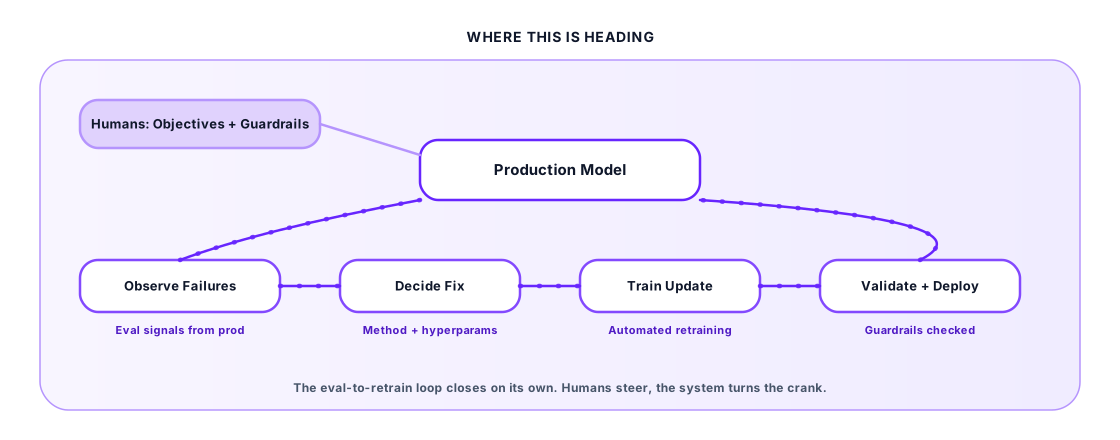
Async RL tolerates a bounded, predictable off-policy delay. The systems layer keeps the gap small by making weight movement a routine background operation. Your algorithm tolerates the rest.
The same kernels run across the trainer and rollouts. Divergences are published per model, and router replay aligns expert selection so training and sampling stay numerically consistent.
Rollouts run on reserved capacity. Start with a small proof of concept to validate the integration, then scale across regions. Talk to our team to size a deployment.