Train open models on your unique capabilities. Serve them at scale. Continuously improve in one fast loop. Your model. Your moat.
Build the intelligence only your company can. Pick your path, from co-development with our proven researchers to running your own training loop. Frontier-grade infrastructure. Elastic compute. No limits on how deep you train.
Go together. Build your model with proven frontier researchers and engineers.
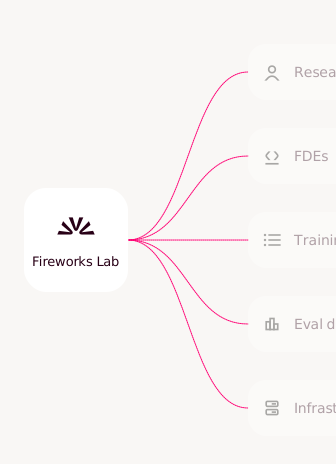
The best models come from two teams, one that knows the domain and one that knows training. Bring your experts and we’ll bring ours. In 6–10 weeks, you’ll ship a model no one else has, trained and deployed on one frontier-grade platform.
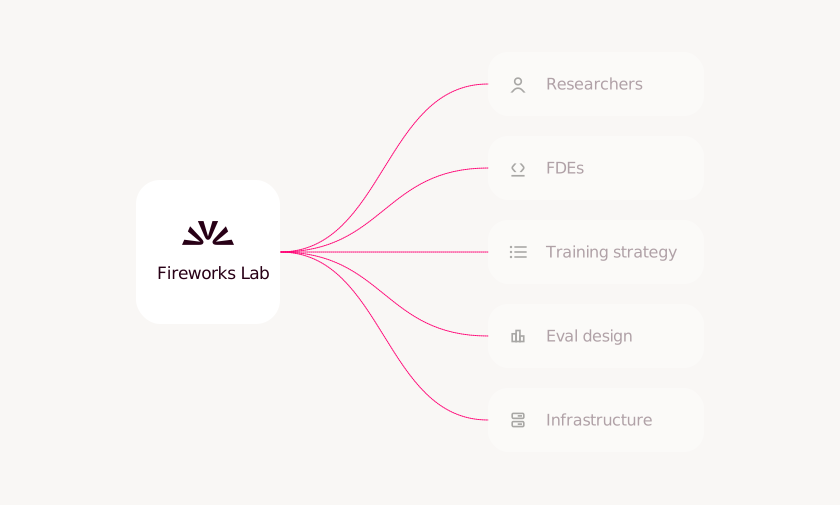
Know you can win before you spend. We confirm your data has the rights, volume, and production fit to train on, and we help you close gaps.
Define the bar for your specialized intelligence. We assess or build evals with your experts and benchmark your models and others against it to reach your targets.
Method and deployment decide your unit economics. We help choose the base model and approach, design serving for cost and latency, and set up retraining as new traces and base models arrive.
Go fast. Pick a method and a model, then run pre-built jobs for SFT, DPO, and ORPO. LoRA only.
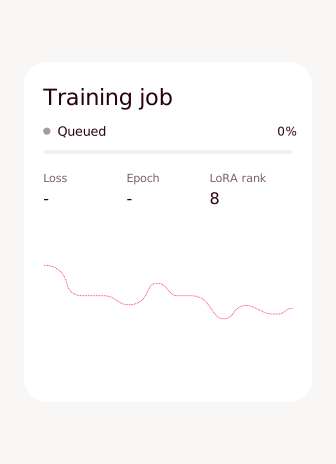
Your data. Your evaluators. Our training loop. Pick a method and a base model, then launch from the UI, CLI, API, or your agent. Fireworks handles scheduling, training, and checkpointing. When the run finishes, deploy your model in one click on the same platform you trained on.
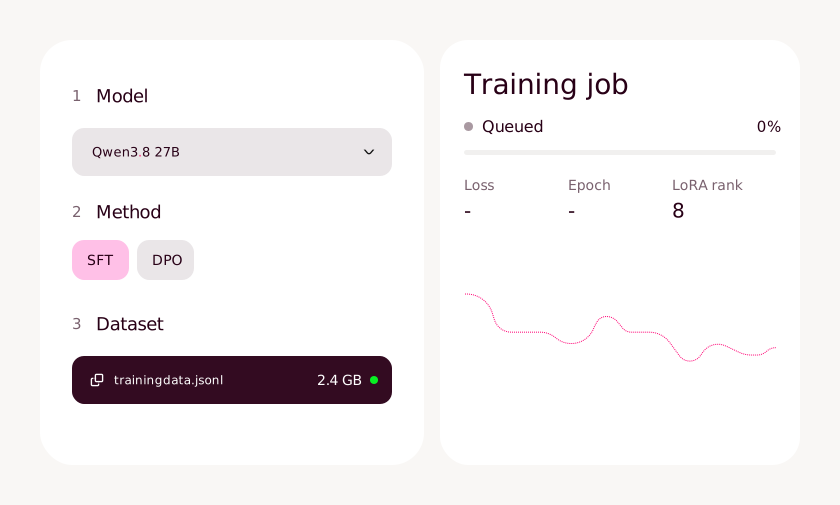
SFT when you have verified examples of the behavior you want. DPO or ORPO for goals you can judge but not measure, like style or helpfulness.
Bring OpenAI-format datasets with no conversion. SFT takes labeled examples, and DPO and ORPO take preferred and rejected response pairs.
Train models like DeepSeek, Qwen, Kimi, Gemma, GLM, and Llama with LoRA. Warm-start from an earlier checkpoint. Serve multiple adapters from one deployment.
Move to the Training API to write RL loops with your own rewards, rollouts, and loss functions.
Go deep. Write the loop and connect to our trainers and samplers. LoRA to full-parameter.
Your data. Your rewards and loss functions. Our infrastructure, proven on RL across 10,000+ GPUs. Write custom training loops in Python. Start with LoRA on serverless, then request dedicated for full-parameter training on the largest MoE models. Our proven frontier researchers can help.
Start right away on an always-on trainer pool. Supports LoRA on popular models. Tinker compatible. Pay per token with no idle GPU charge. Per-account rate limits apply.
Secure your own trainer and deployment. Supports LoRA and full-parameter training on the largest MoE models. Billed by GPU hour. No contention. No rate limits. Scale as much as you need.
Keep it. RL Rollouts handles only the inference side: it hot-loads your checkpoints and runs your rollouts at scale. Proven scale across 10K+ GPUs.
The model you train is the model you serve. Numerics match end to end across BF16, block FP8, and NVFP4, and Router Replay keeps MoE expert choices aligned. Quality holds in production.
Hours per iteration, not weeks. Checkpoints deploy in one click, weights hot-load into running rollouts, and async RL keeps GPUs busy on both halves of the loop.
Elastic compute with on-demand, reserve, and hybrid plans to fit your budget and scale. Our platform keeps GPUs doing useful work at speed across the RL loop. Techniques include: async RL, weight update hot loading, and weight transmission compression.
Full-parameter training on the largest MoE models, on infrastructure proven across 10,000+ GPUs. When a stronger base model ships, retrain on the same platform instead of starting over.
“I mean, the other alternative is we would build one in-house, but we have finite engineers like everybody else. We would prefer to have engineers make training more efficient and more precise rather than spin up an inference effort.”


Every specialized model starts with practical questions about data, security, ownership and cost. Here’s what we hear most.
Fireworks optimizes training and inference together to shorten iteration cycles, help preserve model quality from training to serving, and improve production economics. Our proprietary inference engine also powers RL rollouts, with aligned numerics to support stable learning. Large models, long context, custom losses, and full-parameter training on dedicated compute give you room to pursue demanding workloads. Across serverless and dedicated training, Fireworks manages the infrastructure, so your team can focus on improving the model.
Fireworks Lab adds hands-on research expertise from helping teams such as Harvey and Genspark build specialized models that compete with leading closed models on domain-specific evaluations at lower cost. Our researchers work with your team to define evaluations and develop the training approach around your quality, latency, and cost goals.
Fireworks gives you two ways to train. With Managed Training, Fireworks runs the loop: bring a dataset, pick a base model, and launch an SFT, DPO or ORPO job from the UI, the firectl CLI or the REST API. With the Training API, you write the loop yourself in Python. You control the loss, rewards, rollouts and environments, and you can run reinforcement learning and distillation.
The Training API runs on two kinds of compute: Serverless uses a shared pool, so there’s nothing to provision, and it’s billed per token. Dedicated gives you provisioned trainers and deployments, billed per GPU-hour, and it’s where full-parameter training, DPO/ORPO custom loops and distillation run.
You need three things: a dataset (uploaded to Fireworks, or read from your own cloud bucket), a base model that supports the training method you want, and training GPU quota. Add a payment method and your account gets 32 GPUs each of H200, B200 and B300. If you need more, contact us. Serverless training uses its own shared pool and doesn’t draw on this quota.
We support major open model families, including DeepSeek, Qwen, Kimi, Gemma, GLM and Llama. Support is set per model and per method, so a model can support SFT without supporting DPO. The Models page lists which surfaces and methods each model supports, along with maximum context length. Managed Training uses LoRA. For full-parameter training, opt for the Dedicated Training API.
Yes. You can upload a custom base model and train on it, provided it has a matching Hugging Face URL so Fireworks can find a compatible training configuration. It can take up to 30 minutes after upload for the model to show as ready for training. You can also import LoRA adapters trained elsewhere and serve them on Fireworks.
Training data uses the OpenAI-compatible chat format in a .jsonl file. Datasets can hold between 3 and 3 million examples and can include multi-turn conversations, system messages, tool calls, reasoning traces and per-message weights. DPO and ORPO use single-turn preference pairs: one prompt, a chosen response and a rejected one.
It depends on the method. SFT usually needs hundreds of examples, or roughly 10 million tokens or more. DPO needs hundreds to thousands of preference pairs. RL needs prompts plus a way to score outcomes, and fewer than 100 prompts is often enough.
For SFT, yes. You need verified input/output pairs or successful trajectories. If you don’t have verified outputs but can tell a good result from a bad one (with tests, rules or an LLM judge), reinforcement learning is a better fit.
No. Your training data is never used to train Fireworks-owned or shared models. Inference runs under Zero Data Retention by default.
That depends on how you train. With Managed Training, Fireworks stores your dataset, checkpoints and training traces. If you bring your own bucket (GCS, S3 or Azure Blob), the Fireworks platform reads the dataset in place during the job and never keeps a copy, so we retain only checkpoints and traces. The Training API sends data as short-lived batches and stores no dataset file at all.
Checkpoints and traces are kept for about 30 days by default, and you can ask us to delete them sooner. You can delete datasets from the console or API once a job finishes. For extra control, customer-managed encryption keys (AWS KMS, Google Cloud KMS or Azure Key Vault) encrypt stored datasets and checkpoints with your key. Revoke the key and we can no longer decrypt them.
Yes. For RL, your reward functions, reward models, rollout servers and environments can all stay in your own infrastructure. You don’t need to share them with us.
Yes, you keep the resulting weights. LoRA adapters download with firectl model download in standard Hugging Face PEFT format. An adapter needs the base model it was trained on, so you can download that base model too and merge the two locally if you want to serve outside Fireworks.
A set of prompts and an evaluator that can tell good outcomes from bad ones. That evaluator can be a reward function, a reward model, a verifier or an LLM judge. RL runs on the Training API, and the cookbook has working recipes, including agentic RL. You can use GRPO or write your own objective.
No. Your agent, tools and environment can stay where they are while the Training API handles training. On dedicated training, you can also run rollouts and evaluations on provisioned Fireworks deployments.
Customers can select to deploy trained models to reserved deployments to guarantee steady throughput, on-demand to pay for compute used with no idle billing, or a hybrid to guarantee throughput at a base level and pay on-demand for bursts.
No. You pay for the deployment by the GPU-second, plus the cost of the training job itself.
Managed jobs accept a separate evaluation dataset. While a serverless training session is active, you can sample from checkpoints directly. After training, you can test any promoted model on a preemptible deployment, which borrows idle capacity so you don’t need to reserve GPUs just to run evals.
Yes. Managed jobs integrate with Weights & Biases, so you get full run tracking in your own workspace. The built-in loss and learning-rate charts are kept for 7 days. Setting up Weights and Biases before launching is recommended if you want a longer history.
Managed Training is billed per training token, with rates that scale by model size. The Serverless Training API is billed per token. The Dedicated Training API is billed per GPU-hour. See fireworks.ai/pricing for current rates, or estimate a job with the cost estimator. For help with pricing, talk to an expert.
Train, serve, and continuously improve your own models.