Train open models on your unique capabilities. Serve them at scale. Continuously improve in one fast loop. Your model. Your moat.
Make Muse Glimmer your own with SFT, DPO, or RL. Start in the app, via API, or with your coding agent. No credit card required.
Build the intelligence only your company can. Pick your path, from co-development with our proven researchers to running your own training loop. Frontier-grade infrastructure. Elastic compute. No limits on how deep you train.
Go together. Build your model with proven frontier researchers and engineers.
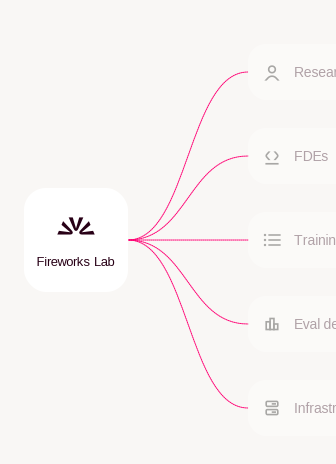
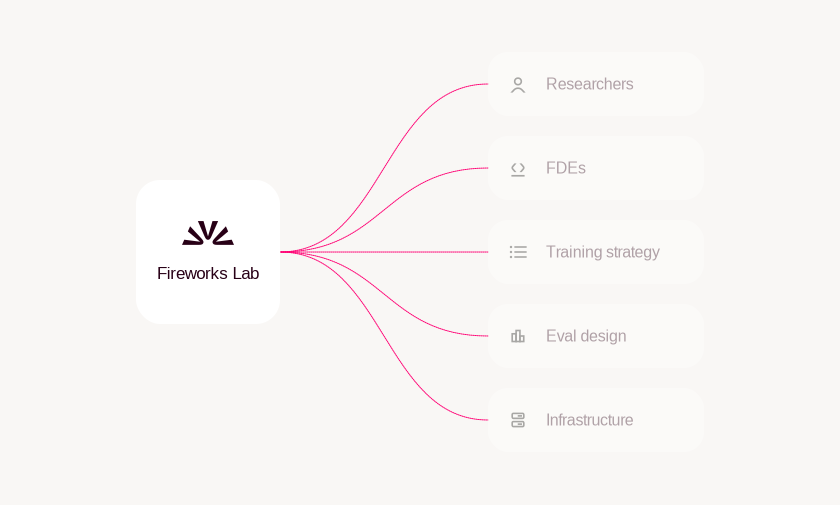
The best models come from two teams, one that knows the domain and one that knows training. Bring your experts and we’ll bring ours. In 6–10 weeks, you’ll ship a model no one else has, trained and deployed on one frontier-grade platform.
Know you can win before you spend. We confirm your data has the rights, volume, and production fit to train on, and we help you close gaps.
Define the bar for your specialized intelligence. We assess or build evals with your experts and benchmark your models and others against it to reach your targets.
Method and deployment decide your unit economics. We help choose the base model and approach, design serving for cost and latency, and set up retraining as new traces and base models arrive.
Go fast. Let your coding agent run training with ready-to-run recipes. Track progress and deploy from the dashboard.
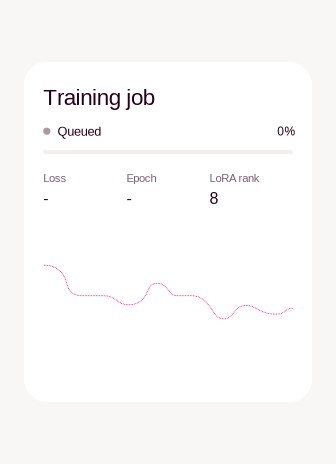
Start with low-code, pre-packaged training cookbooks, or let your coding agent help write your own loop. Fireworks skills help you configure, launch, and troubleshoot training through the Training API. Track progress, inspect loss curves, and deploy your model from the dashboard.
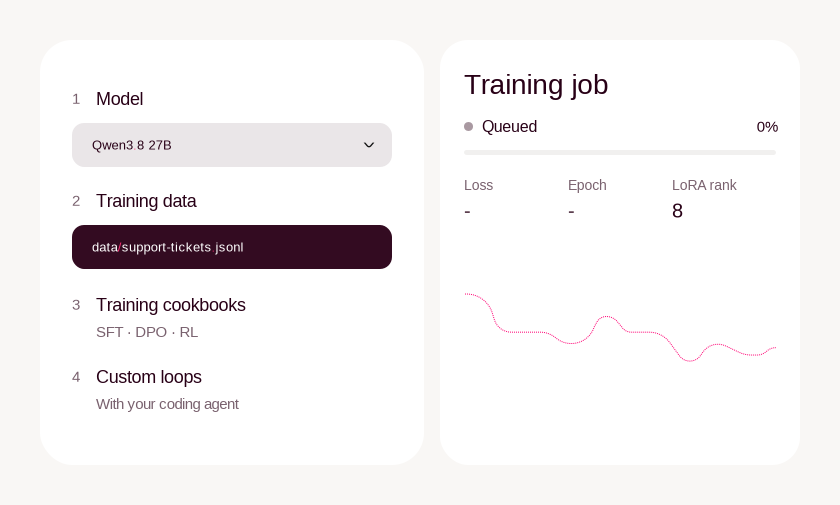
Use Fireworks skills in Claude Code, Cursor, or Codex to configure, launch, and troubleshoot training runs.
Get training underway with low-code, pre-packaged cookbooks. Adapt the data and settings to your task without building a loop from scratch.
Fine-tune models like Qwen, Kimi, and GLM with LoRA to improve how they handle your task, using your own training data.
Move to the Training API to write RL loops with your own rewards, rollouts, and loss functions.
Go deep. Write the loop and connect to our trainers and samplers. LoRA to full-parameter.
Your data. Your rewards and loss functions. Our infrastructure, proven on RL across 10,000+ GPUs. Write custom training loops in Python. Start with LoRA on serverless, then request dedicated for full-parameter training on the largest MoE models. Our proven frontier researchers can help.
Start right away on an always-on trainer pool. Supports LoRA on popular models. Tinker compatible. Pay per token with no idle GPU charge. Per-account rate limits apply.
Secure your own trainer and deployment. Supports LoRA and full-parameter training on the largest MoE models. Billed by GPU hour. No contention. No rate limits. Scale as much as you need.
Keep it. RL Rollouts handles only the inference side: it hot-loads your checkpoints and runs your rollouts at scale. Proven scale across 10K+ GPUs.
The model you train is the model you serve. Numerics match end to end across BF16, block FP8, and NVFP4, and Router Replay keeps MoE expert choices aligned. Quality holds in production.
Hours per iteration, not weeks. Checkpoints deploy in one click, weights hot-load into running rollouts, and async RL keeps GPUs busy on both halves of the loop.
Elastic compute with on-demand, reserve, and hybrid plans to fit your budget and scale. Our platform keeps GPUs doing useful work at speed across the RL loop. Techniques include: async RL, weight update hot loading, and weight transmission compression.
Full-parameter training on the largest MoE models, on infrastructure proven across 10,000+ GPUs. When a stronger base model ships, retrain on the same platform instead of starting over.
“I mean, the other alternative is we would build one in-house, but we have finite engineers like everybody else. We would prefer to have engineers make training more efficient and more precise rather than spin up an inference effort.”


Every specialized model starts with practical questions about data, security, ownership and cost. Here’s what we hear most.
Fireworks optimizes training and inference together to shorten iteration cycles, help preserve model quality from training to serving, and improve production economics. Our proprietary inference engine also powers RL rollouts, with aligned numerics to support stable learning. Large models, long context, custom losses, and full-parameter training on dedicated compute give you room to pursue demanding workloads. Across serverless and dedicated training, Fireworks manages the infrastructure, so your team can focus on improving the model.
Fireworks Lab adds hands-on research expertise from helping teams such as Genspark build specialized models that compete with leading closed models on domain-specific evaluations at lower cost. Our researchers work with your team to define evaluations and develop the training approach around your quality, latency, and cost goals.
Start with Training Skills for low-code cookbooks and coding-agent assistance, including help writing custom loops. Use the Training API directly when you want to write and control the training workflow yourself. Both use the same Fireworks training infrastructure. For hands-on help with data, evaluations, and model development, work with Fireworks Lab.
Choose serverless compute to start without provisioning GPUs, or dedicated compute for broader model support and full-parameter training.
You need a Fireworks API key, a supported base model, and data suited to your training task. For reinforcement learning, you also need a way to score the model’s outputs. Start with a cookbook example or let your coding agent help configure the run.
Serverless training requires no GPU provisioning. Dedicated training requires sufficient account quota and available capacity.
Choose from supported open models for your task. Availability depends on the model, training method, and compute option. Serverless supports LoRA training; dedicated compute supports LoRA and full-parameter training. See the Models page for current support and context limits.
Yes. You can upload a custom base model and train on it, provided it has a matching Hugging Face URL so Fireworks can find a compatible training configuration. It can take up to 30 minutes after upload for the model to show as ready for training. You can also import LoRA adapters trained elsewhere and serve them on Fireworks.
Training data uses the OpenAI-compatible chat format in a .jsonl file. Datasets can hold between 3 and 3 million examples and can include multi-turn conversations, system messages, tool calls, reasoning traces and per-message weights. DPO and ORPO use single-turn preference pairs: one prompt, a chosen response and a rejected one.
It depends on the method. SFT usually needs hundreds of examples, or roughly 10 million tokens or more. DPO needs hundreds to thousands of preference pairs. RL needs prompts plus a way to score outcomes, and fewer than 100 prompts is often enough.
For SFT, yes. You need verified input/output pairs or successful trajectories. If you don’t have verified outputs but can tell a good result from a bad one (with tests, rules or an LLM judge), reinforcement learning is a better fit.
No. Your training data is never used to train Fireworks-owned or shared models. Inference runs under Zero Data Retention by default.
With the Training API, your source dataset stays in your environment. Fireworks processes the batches you send, and results may remain available after an operation completes so you can retrieve them or retry a request.
Fireworks applies a 30-day storage lifecycle to checkpoints and the training logs and metrics you see. Checkpoints let you resume training or use your trained model. Exported or promoted models follow a separate lifecycle. For retention periods and deletion options specific to your setup, contact your Fireworks account team.
Yes. For RL, your reward functions, reward models, rollout servers and environments can all stay in your own infrastructure. You don’t need to share them with us.
Yes, you keep the resulting weights. LoRA adapters download with firectl model download in standard Hugging Face PEFT format. An adapter needs the base model it was trained on, so you can download that base model too and merge the two locally if you want to serve outside Fireworks.
A set of prompts and an evaluator that can tell good outcomes from bad ones. That evaluator can be a reward function, a reward model, a verifier or an LLM judge. RL runs on the Training API, and the cookbook has working recipes, including agentic RL. You can use GRPO or write your own objective.
No. Your agent, tools and environment can stay where they are while the Training API handles training. On dedicated training, you can also run rollouts and evaluations on provisioned Fireworks deployments.
Customers can select to deploy trained models to reserved deployments to guarantee steady throughput, on-demand to pay for compute used with no idle billing, or a hybrid to guarantee throughput at a base level and pay on-demand for bursts.
No. You pay for the deployment by the GPU-second, plus the cost of the training job itself.
Compare the trained model with your baseline on held-out examples from your task. Measure output quality alongside response time and cost. You can sample from saved checkpoints during training to check progress, then evaluate the final model before deploying it.
Yes. Use the dashboard to view training jobs and loss curves, and connect cookbook runs to Weights & Biases for experiment tracking and additional metrics in your own workspace.
Serverless training is billed per token, with no idle GPU charge. Dedicated training is billed for provisioned compute time. Training Skills uses the underlying Training API, so training charges depend on the compute option you choose. See our pricing page for current rates.
Train, serve, and continuously improve your own models.